
We independently research and test every product we recommend. When you buy through our links, we may earn a commission. Learn more

The 5 Best Portable Tire Inflators of 2026

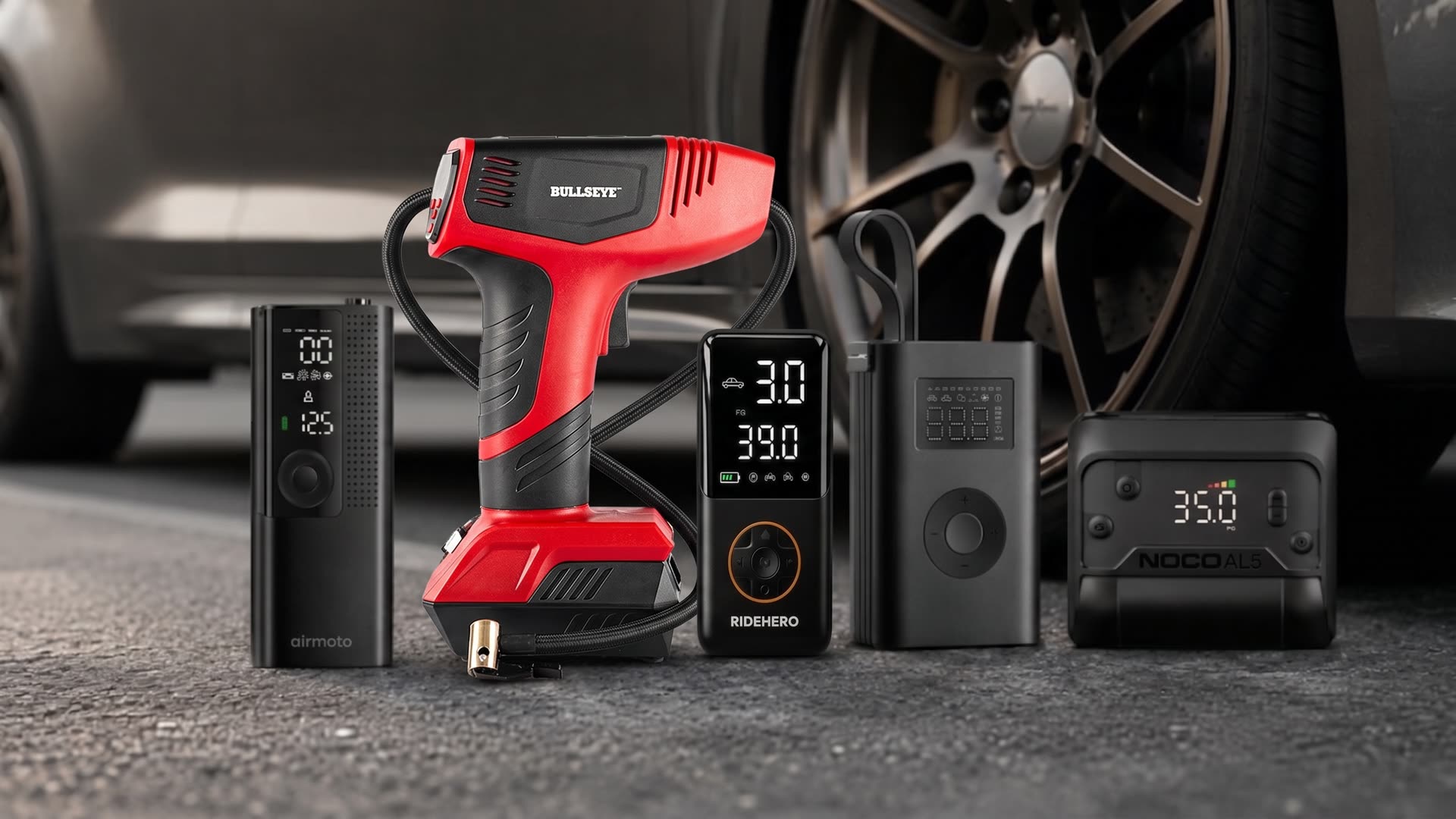
Portable tire inflators lined up next to a car wheel

Portable tire inflators have exploded in popularity with daily commuters, road-trippers, and anyone who's tired of hunting for a working gas-station air pump. Roughly 30% of new vehicles no longer even ship with a spare[5] — so having a reliable way to add air on the spot has gone from a nice-to-have to something worth keeping in every vehicle.

The problem is that quality varies wildly. Cheap models with weak motors and inaccurate gauges are everywhere, and it's hard to tell which ones actually hold up until you've used one on the side of the road. We purchased, tested, and compared today's most popular portable tire inflators over 60 days, evaluating inflation speed, auto-stop accuracy, portability, battery life, and overall value.

After our testing, here are the 5 portable tire inflators we recommend for 2026:

About the reviewer

Jordan Mills Product Tester, Top5TireSafety

Jordan has spent 8 years testing automotive and outdoor gear, checking real-world inflation times and battery claims by hand before anything makes the list.

★ Editor's Choice · 2026

#1 Overall Pick

RideHero portable tire inflator

RideHero Portable Tire Inflator

A+Grade
9.8/10

Overall Analysis

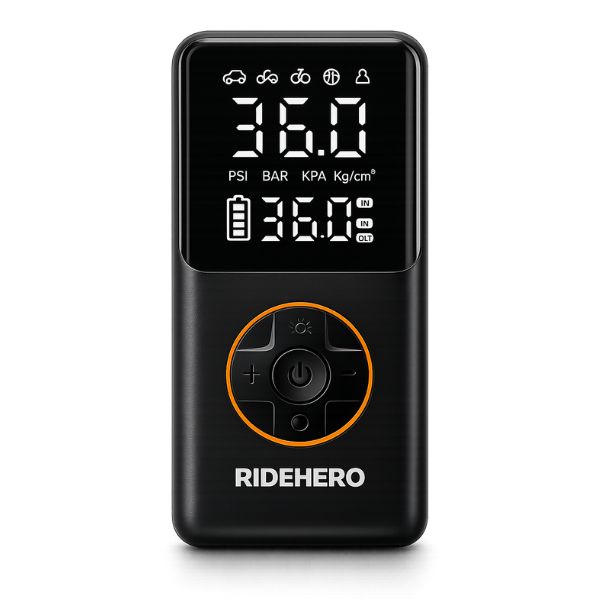
The RideHero is the most complete portable tire inflator we tested, and by a clear margin. It's fully cordless, runs on a rechargeable battery, and covers cars, SUVs, motorcycles, bikes, and sports equipment with the included adapter kit — no separate tools needed for each use case.

In real-world testing it inflated a bike tire in 0:58, a basketball in 0:15, a car tire in 2:45, and an SUV tire in 2:00; motorcycle tires took longer at 4–8 minutes, which tracks given the larger volume. The auto-stop presets mean you dial in a target PSI, press start, and walk away — no standing over the tire watching a gauge.

It charges over USB-C and doubles as a backup power source in a pinch. The one real limitation: it's currently sold only through the official RideHero site, not through third-party retailers.

What stands out most once you line it up against the rest of this list: RideHero costs noticeably less than several inflators that scored lower across our testing — you're not paying a premium for the best performance here, which is unusual for the category.

Ratings

Inflation Speed 97%
Auto-Stop Accuracy 98%
Cordless Portability 99%
Battery Capacity 96%
Emergency Features 98%
98%RideHero Portable Tire Inflator Score
Pros
  • Costs less than several inflators on this list that scored lower
  • Auto-stop presets remove all the guesswork
  • Large, easy-to-read LED display
  • USB-C rechargeable, doubles as a compact power bank
  • Complete adapter kit for cars, bikes, motorcycles, and sports gear
  • Compact enough for a glovebox or bag
Cons
  • Currently sold only through the official RideHero site
  • Motorcycle tires take noticeably longer (4–8 min) than car tires

The Bottom Line

RideHero earns our top spot by combining genuinely fast inflation, foolproof auto-stop, and the widest real-world versatility of anything we tested — all while costing less than several inflators that scored lower.
#2

AirMoto portable tire inflator

AirMoto

B+Grade
8.8/10

Overall Analysis

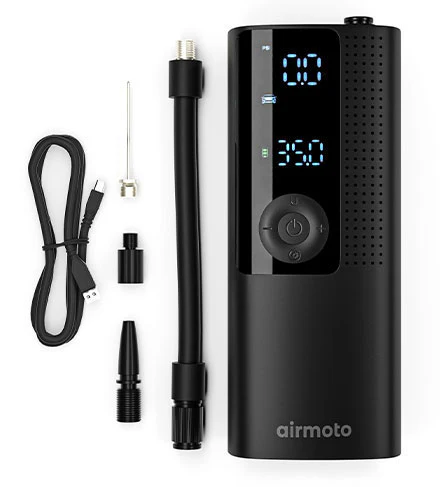
AirMoto is the most compact cordless option we tested, at roughly 1.25 lbs — small enough to disappear into a glovebox or backpack without a second thought. It ships with adapters for Schrader, Presta, needle, and general valves, covering cars, bikes, and most inflatables.

Where it gives ground is pressure ceiling: it caps out at 120 PSI, lower than the two leaders on this list, which is plenty for a car or bike but leaves less headroom for larger tires. During extended runs it also generates some noticeable heat and vibration.

It's a strong secondary pump or a good pick if compact size matters more to you than maximum output, though its price sits a bit higher than a few inflators that scored similarly in our testing.

Price tier: $$$ View on amazon

Ratings

Inflation Speed 88%
Auto-Stop Accuracy 93%
Cordless Portability 96%
Battery Capacity 85%
Emergency Features 80%
88%AirMoto Score
Pros
  • Ultra-compact and lightweight (~1.25 lbs, fits in a glovebox)
  • Comes with multiple valve adapters (Schrader, Presta, needle, general)
Cons
  • Reaches up to 120 PSI
  • Generates some heat and vibration/noise during extended use

The Bottom Line

AirMoto's size and adapter kit make it an easy carry-along, though its 120 PSI ceiling and higher price keep it a step behind the leaders.

#3

Bullseye Pro tire inflator

Bullseye Pro

BGrade
8.5/10

Overall Analysis

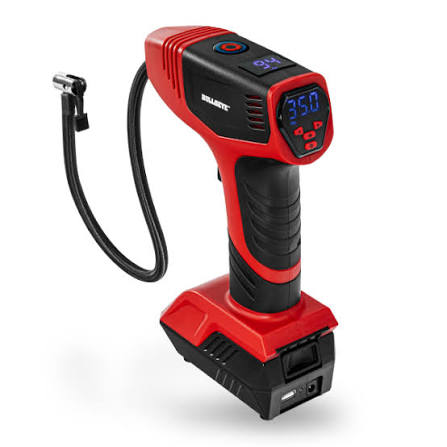
Bullseye Pro stands out for a genuinely different design: instead of holding it against the valve stem, you lock the nozzle on and set it down on its rubberized feet next to the tire — it stands on its own and inflates hands-free while you do something else. It delivers up to 120 PSI and comes with a sports-ball adapter, two additional fill adapters, and a dedicated storage compartment built into the base.

The real-world numbers hold up: one owner logged four tires, each needing 10–15 PSI topped off, at roughly two minutes per tire, using only 60% of a full charge. It charges over USB-C (a standard phone charger works) and ships with a 12V car charger as backup, plus a built-in LED for nighttime use.

The battery is a proprietary rechargeable pack rather than a swappable off-the-shelf cell, so a replacement down the road comes from the manufacturer directly. A few owners also note it feels a bit pricier than expected for what it does.

Price tier: $$ View on amazon

Ratings

Inflation Speed 87%
Auto-Stop Accuracy 90%
Cordless Portability 90%
Battery Capacity 82%
Emergency Features 78%
85%Bullseye Pro Score
Pros
  • Hands-free design — stands on its own, no need to hold the nozzle or trigger
  • Includes a sports-ball adapter, two extra fill adapters, and built-in storage
  • Delivers up to 120 PSI with genuinely fast real-world fill times
Cons
  • Proprietary battery pack isn't swappable with off-the-shelf cells
  • A few owners feel it's pricier than expected for what it does

The Bottom Line

Bullseye Pro's hands-free, set-it-and-walk-away design is genuinely different from everything else on this list, and the real-world numbers back up the marketing.

#4

HOTO portable tire inflator

HOTO

B+Grade
8.6/10

Overall Analysis

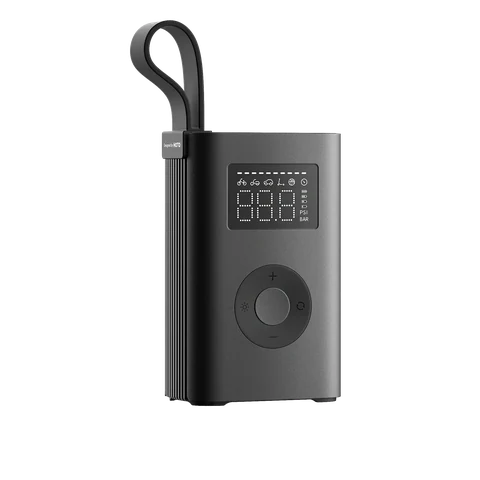
HOTO is the most design-forward inflator we tested — sleek, minimalist, and clearly built for buyers who care about how the thing looks sitting in the trunk, not just what it does. It offers multiple smart presets (auto, bike, motorcycle, manual) across a wide 3–150 PSI range.

The catch is battery capacity: it's advertised with 2×2000 mAh cells, but at least one independent teardown found real capacity closer to a single 2000 mAh cell — good for roughly 4–5 tires per charge instead of the claimed 10. Entry-level units also ship with a hose that's a bit short, making valve connections awkward on the trail.

The screen can be hard to read in direct sunlight on some units. It's still a capable all-rounder for typical use, just one where the spec sheet oversells the battery a little.

Price tier: $$$ View on amazon

Ratings

Inflation Speed 90%
Auto-Stop Accuracy 85%
Cordless Portability 88%
Battery Capacity 72%
Emergency Features 75%
86%HOTO Score
Pros
  • Sleek, minimalist design — well-liked aesthetically
  • Multiple smart presets (auto, bike, motorcycle, manual), PSI range 3–150
Cons
  • Entry-level models have a hose that's too short, making valve connection awkward (especially on trail)
  • Battery specs have been reported as misleading — real capacity closer to 4–5 tires per charge instead of the claimed 10
  • Screen can be hard to read in direct sunlight on some models

The Bottom Line

HOTO looks and feels premium, but the gap between its advertised and real battery capacity is worth knowing before you buy.

#5

NOCO AIR10 portable tire inflator

NOCO (AIR Series: AIR10)

BGrade
8.3/10

Overall Analysis

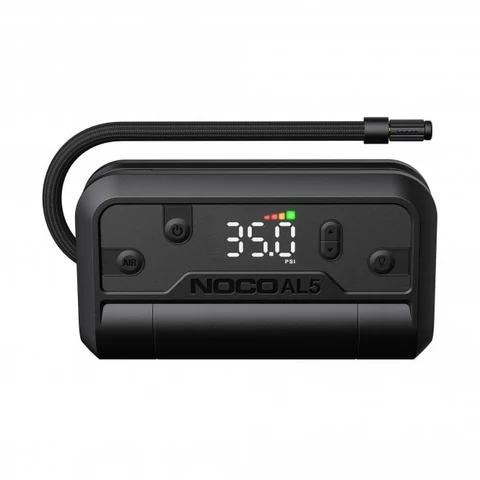
The NOCO AIR10 is built around Smart Pressure Technology, which pauses and resumes inflation automatically to prevent over-inflation — a nice touch of precision that outperforms simpler auto-stop systems in our testing.

It's also genuinely fast tire-by-tire. The tradeoff is its ceiling: capped at 60 PSI, noticeably lower than everything else on this list, which rules it out for anything beyond standard car and light SUV tires. It's a corded, 12V design rather than cordless, and its larger footprint makes it less of a grab-and-go tool.

Between the price, the cord, and the lower PSI cap, it's best suited to living in the garage rather than riding in the glovebox for emergencies.

Price tier: $$$$ View on amazon

Ratings

Inflation Speed 85%
Auto-Stop Accuracy 92%
Cordless Portability 50%
Battery Capacity 60%
Emergency Features 65%
83%NOCO AIR10 Score
Pros
  • Very fast inflation across the line
  • Smart Pressure Technology pauses/resumes to prevent overinflation
Cons
  • Higher price point than most competitors
  • AIR10 capped at only 60 PSI — not enough for some vehicle types

The Bottom Line

The AIR10 is fast and precise for garage use, but its 60 PSI cap and corded design make it the least portable pick on this list.

The Basics

What Is a Portable Tire Inflator?

A portable tire inflator is a small, motorized air pump you keep in the car, garage, or trunk so you're never stuck waiting for a gas station air machine to be free — or working. Plug it in or charge it up, set your target PSI, and it fills the tire on its own. Quality varies a lot across the models on the market, and it mostly comes down to three things: motor power, battery reliability, and how accurately the device actually measures pressure.

Benefits of Owning One

  • Fills car, SUV, bike, and motorcycle tires roadside — no gas station needed
  • Auto-stop presets mean no standing over the tire watching a gauge
  • Cordless, rechargeable models skip tangled dashboard cables entirely
  • Many double as a backup phone charger or built-in flashlight
  • One tool covers cars, bikes, sports balls, and pool inflatables alike
  • Keeping tires at the right pressure improves handling and fuel economy

What to Consider When Choosing One

Maximum Pressure Output

Look for at least 120–150 PSI so the motor isn't struggling on car and SUV tires. Lower-limit units take longer and tend to run hot.

Auto-Stop Accuracy

A model that shuts off automatically at your target pressure removes the guesswork — and the risk of over-inflating a tire by accident.

Cordless vs. Corded

Cordless, battery-powered units reach all four tires without stretching a cable through the car. Corded 12V models are usually cheaper but limited by cable length and your outlet.

Included Adapters

Check that it ships with adapters for bikes, sports balls, and inflatables — not just the standard car valve — if you want to actually use it beyond the car.

Display & Lighting

A digital display that's readable in direct sunlight, and a built-in LED, matter more than they sound the first time you're dealing with a flat after dark.

Real Battery Capacity

Advertised mAh numbers aren't always what they seem. How many full tire top-offs you get per charge is the number that actually matters.

What to Avoid

Analog-Only Gauges

Needle gauges vibrate hard while the motor runs, making it nearly impossible to get an accurate reading without stopping repeatedly to check.

Bulky Cord-Only Designs

Older corded units rarely reach the rear tires of an SUV comfortably. A modern inflator should run fully on its own battery.

Single-Purpose Pumps

A pump that only handles car tires is a missed opportunity for limited glovebox space — look for one that pulls double duty.

FAQ

Common Questions

Most manufacturers recommend checking tire pressure at least once a month, and always before a long road trip. Pressure also drops with colder weather, so it's worth a quick check whenever the temperature shifts significantly.

Yes, in most cases — it just takes longer than topping off a low tire. Keep in mind a portable inflator won't seal a puncture on its own; some kits pair with a sealant for that, but a completely flat tire from a large puncture may still need a repair or replacement.

Not if it has auto-stop. You set a target PSI before starting, and the pump shuts off automatically once that pressure is reached — no need to babysit it. Manual, gauge-only pumps don't have this safeguard, which is one reason we favor auto-stop models.

Yes, as long as you use the correct adapter and pay attention to the recommended pressure for that item — a basketball or pool float needs far less PSI than a car tire, and most auto-stop presets account for that.

It varies by model — a full charge is typically good for several tire top-offs before it needs to be recharged again. Real-world capacity can differ from what's advertised, which is why we weigh it as its own testing category above.

A combination of real inflation speed, accurate auto-stop, honest battery specs, and how many different things it can actually be used on — not just the PSI number printed on the box.

Not really — every inflator on this list has a built-in digital gauge, and the auto-stop models we tested were accurate to within a couple PSI of a calibrated external gauge. A separate gauge is only worth carrying as a backup if you want a second opinion.

It depends on the model's maximum PSI and how large the tire is. RVs and trailers often run higher pressures than a passenger car, so check the inflator's rated ceiling against your tire's recommended PSI before relying on it for anything bigger than a standard car or SUV tire.

PSI is how much pressure the motor can ultimately push against; airflow rate (measured in liters per minute) is how quickly it moves air. A high PSI rating with a low airflow rate can still mean a slow fill — that's why we time real tires in our testing instead of just comparing spec sheets.